Call for Papers | MSA Forward 2026 – Buenos Aires
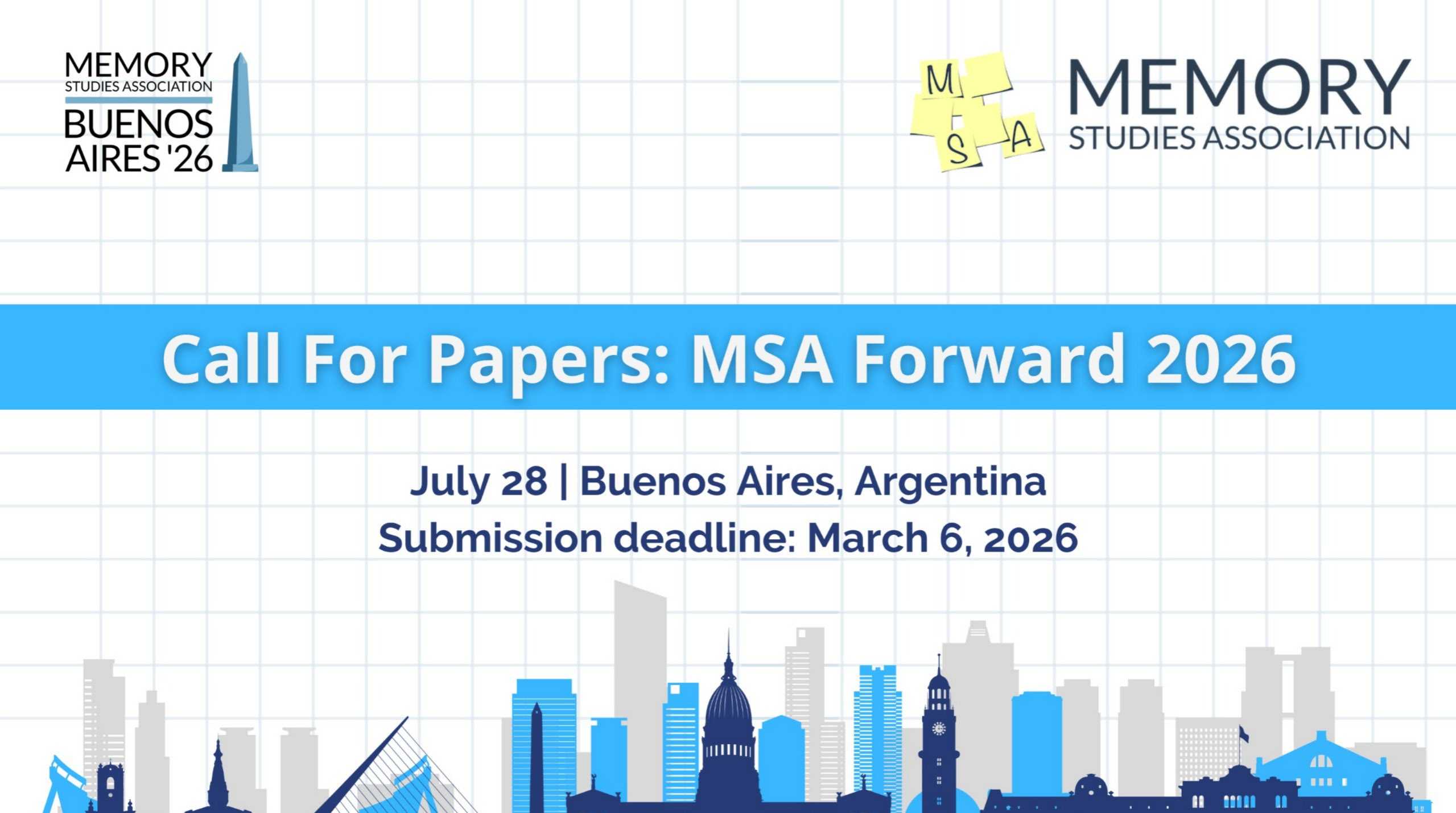
The Memory Studies Association (MSA) invites submissions for MSA Forward 2026, a workshop for advanced doctoral students dedicated to memory studies. As part of the 10th Annual MSA Conference, the workshop will take place on July 28, 2026, at Torcuato Di Tella University in Buenos Aires, providing an opportunity for training, exchange, and the consolidation of research networks.
In line with previous editions, the MSA Forward is organized as a working platform for emerging scholars to present their work in progress, interact with established scholars in their fields of study, and receive feedback. The workshop provides an appropriate space for constructive discussion, collective elaboration, and interdisciplinary exchange.
The workshop will be organized in both English and Spanish. Panels will be conducted either in a single language or in a bilingual format, depending on the composition of each session.
Thematic Areas
Proposals may address any of the following thematic areas, as well as other topics related to the general theme of the MSA 2026 Annual Conference: Memory and Democracy.
1. Memory Politics, Transmission, and Transitional Justice: The configuration and contestation of memory politics in national and transnational contexts. It includes approaches to memory pedagogies, generational transmission, and studies of audience and visitor experiences in memory spaces. Furthermore, it includes research on reparation policies and transitional justice mechanisms aimed at confronting past violence and human rights violations. Special attention is paid to the role of activism, the interactions between state and non-state actors, and the ways in which these interventions affect the consolidation of democratic values, social inclusion, and pluralism.
2. Reactions and Denialism: The impact of reactionary discourses, disinformation campaigns, and new forms of denialism in contemporary debates on memory. The production of banalizing, denialist, and/or celebratory narratives of state repression and human rights violations, as well as the processes that erode social consensus on the recognition of these traumatic pasts.
3. Art, Media, and Cultural Productions of Memory: The representations of the past in visual arts, literature, cinema, performance practices, and the media. The role of productions as spaces for elaboration, intervention, and contestation, as well as their capacity to shape public imaginaries and collective meanings.
4. Digital Technologies and Memory: The ways in which digital technologies transform social memory practices, from online archives to social networks, digital platforms, algorithms, and artificial intelligence. The ethical, political, and epistemological challenges associated with the production, circulation, and preservation of memories in contemporary digital environments.
5. Intersectionality, Memory, and Human Rights: Intersectionality as a theoretical and political approach to contemporary memorial processes. The hierarchies of gender, race, class, and sexuality on memory practices. It includes feminist, anti-racist, decolonial and queer perspectives that analyze the contributions of these and other movements to the field of memory, as well as their interventions for the transformation of dominant narratives, the broadening of listening frameworks, and the contestation of forms of silencing and invisibilization. It also considers the ways in which gender perspectives and intersectional approaches allow us to revise our understanding of the past and its persistence in the present.
6. Theoretical and Methodological Approaches for Memory Studies: The innovative methodological approaches within the field of memory studies. The conceptual and methodological frameworks, the analytical tools and novel strategies for examining memorial processes across diverse contexts. Special attention is given to work contributions, reflections on research design, and projects that enable discussion about how knowledge on memory-its practices, actors, and materialities-is produced.
Submission Guidelines
Applicants must submit an abstract of up to 300 words, in either Spanish or English, that clearly presents the research problem, the theoretical and methodological approach, and the central analytical contribution of the work within the field of memory studies.
Please include the following with your submission:
● Full name and institutional affiliation
● Contact information
● Language preference
● Abstract (max 300 words)
● Academic biography (max 150 words, third person)
Each participant may submit only one proposal. Please submit your application via this form.
Authors whose proposals are accepted will be required to submit a full paper in Spanish or English prior to the workshop, according to the deadlines indicated in the schedule, in order to facilitate pre-circulation among commentators and participants. Papers should be 8–10 pages in length, written in Times New Roman 12 with 1.5 line spacing and will be presented orally in a 15-minute format.
General Considerations regarding the Workshop
MSA Forward 2026 is organized as a space for exchange in which each participant presents work-in-progress from their research while also taking part in a collective discussion. The workshop will take place in person in Buenos Aires, Argentina. Each paper will receive comments from an invited scholar with experience in the field.
Schedule
● Submission deadline: March 6, 2026
● Notification of acceptance: April 3, 2026
● Submission of full papers: July 12, 2026
● MSA Forward 2026 Workshop: July 28, 2026 (Buenos Aires)
Additional Information
Membership: All individuals accepted to present at MSA Forward 2026 must be active members of the Memory Studies Association. Updated information on membership fees and categories is available on the MSA website. Scholars based in Argentina will be eligible for cost free membership but will still need to sign up.
Presentation Exclusivity: Applicants should note that they may only present their work at either the MSA Conference or MSA Forward. If a proposal is accepted in both instances, the applicant must choose which one they will present at.
Workshop Fee: Participants must pay a fee of €50 to participate in the MSA Forward. This ticket will subsequently give access to all events that are part of the main MSA 2026 (panels, workshops, plenary sessions, etc.).
Financial Support: It is possible to apply to the MSA for a conference grant (for travel, accommodation, conference fees). However, since the number of grants available is very limited, participants in the MSA Forward are strongly encouraged to seek funding through their home institutions.
For inquiries: msaforward@